
From Loom to Luxury: The Hand-Weaving Process Explained
Have you ever held a piece of beautiful, hand-woven tweed and wondered about the magic within its threads? The world of weaving, with its talk of warp, weft, and heddles, can often feel like a secret language, a craft shrouded in mystery. Yet, at its heart, it is a simple and timeless story of human artistry, where a weaver's skilled loom hand patiently guides each thread to create something truly extraordinary and built to be cherished.
Here, we invite you to step into that world with us. We will gently pull back the curtain on this beautiful tradition, explaining everything from the simple mechanics of the loom to the intricate process that brings a luxurious fabric to life. You won’t just learn the difference between handmade and machine-made; you’ll feel a heartfelt connection to the heritage and skill stitched into every piece, appreciating the unique character that only true craftsmanship can create.
Key Takeaways
- Discover the simple, timeless mechanics of a hand loom and what truly sets this cherished craft apart from mass production.
- Follow the thoughtful journey of a single thread as it's prepared for the loom hand-weaving process to become part of a finished fabric.
- Uncover the weaver's secret to creating beautiful, intricate patterns like tweed with simple, skilful changes in lifting the threads.
- Learn why hand-woven fabric holds so much more than just thread-it carries a story, a connection to heritage, and a truly personal touch.
What is a Hand Loom? The Heart of a Timeless Craft
At its core, a hand loom is a beautifully simple yet powerful frame, designed for one of humanity's oldest and most cherished crafts: weaving. It’s more than just a tool; it's the heartbeat of the weaver's workshop, where threads of yarn are thoughtfully interlaced to create fabric. The rhythmic clatter of the shuttle and the gentle push of the beater are sounds that have echoed through millennia, connecting us to a rich heritage of making things by hand. This deliberate, creative process, guided by a skilled loom hand, stands in beautiful contrast to the rush of the modern world, transforming simple yarn into a piece of timeless textile art.
The Hand Loom vs. The Power Loom
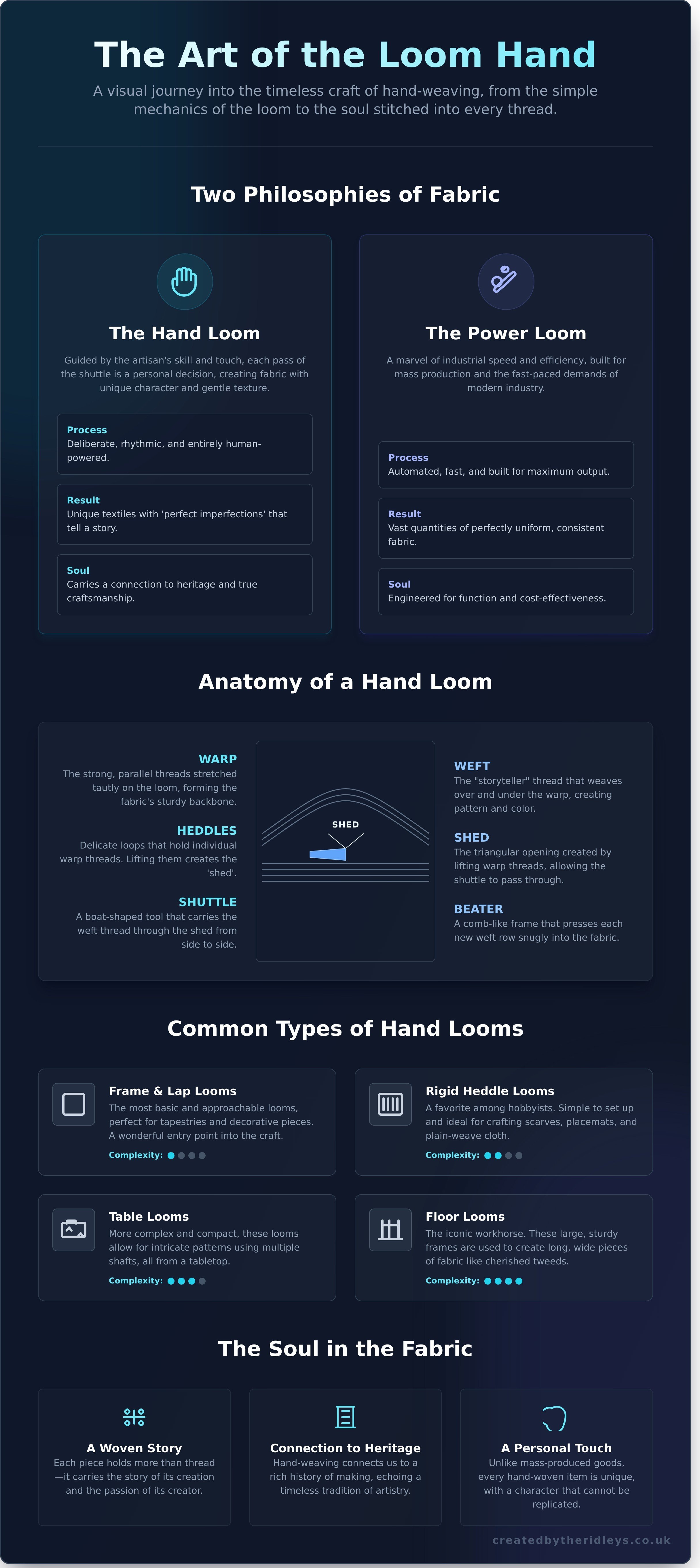
In the world of textiles, these two looms represent entirely different philosophies. The industrial power loom is a marvel of speed and efficiency, built for mass production. It creates vast quantities of uniform fabric, perfect for the fast-paced demands of modern industry. The hand loom, however, tells a different story. It relies entirely on the artisan's skill, touch, and direct control. Each pass of the shuttle is a personal decision, resulting in a fabric with a unique character, a gentle texture, and those 'perfect imperfections' that are the signature of something truly handmade.
Common Types of Hand Looms for Artisans
Just as there are many types of stories to tell with thread, there are different looms to help tell them. While the fundamental principles are shared across all weaving, understanding the anatomy of a hand loom reveals the clever variations that suit different purposes. For artisans, the choice of loom often depends on the project's scale and intricacy:
- Frame & Lap Looms: The most basic and approachable form, often used for creating beautiful tapestries and small decorative pieces. They are a wonderful entry point into the craft.
- Rigid Heddle Looms: A favourite among hobbyists, these are simple to set up and perfect for crafting scarves, placemats, and lengths of plain-weave cloth.
- Table Looms: More complex than a rigid heddle, these compact looms allow weavers to create more intricate patterns using multiple shafts, all from a tabletop.
- Floor Looms: The iconic, traditional loom. These large, sturdy frames are the workhorses for creating long, wide pieces of fabric, including the beautiful tweeds we cherish so dearly.
The Anatomy of a Hand Loom: Understanding the Weaver's Tools
At first glance, a traditional hand loom can seem a wonderfully complex piece of heritage woodwork, a relic from a bygone era. But at its heart, it is simply a frame designed to hold threads in place, much like an artist’s easel holds a canvas. The threads are the weaver's paint, and the loom is the structure that allows a beautiful picture to emerge, thread by thoughtful thread. To truly appreciate the magic woven into every handmade piece, it helps to understand the tools that bring it to life. Getting to know the parts of the loom hand-in-hand with the weaver’s skill reveals the beautiful, intentional process behind the fabric.
Warp and Weft: The Soul and Story of the Fabric
Every piece of woven cloth begins with two fundamental elements, a partnership of strength and story. The warp threads are the soul of the fabric; a series of strong, parallel yarns stretched tautly from the front to the back of the loom, forming a sturdy, silent backbone. Then comes the weft, the storyteller. This is the thread that travels back and forth, weaving over and under the warp to introduce colour, pattern, and character. It is the beautiful interplay between these two that creates the strong, cherished cloth we know and love.
Heddles and the Shed: Creating Space for Weaving
But how does the weft thread make its journey through that tight grid of warp threads? This is where the quiet ingenuity of the loom truly shines. Each individual warp thread is passed through a small, delicate loop called a heddle. By pressing pedals or lifting levers, the weaver raises specific heddles, which in turn lift their designated warp threads. This action creates a neat, triangular opening called the shed. This simple, yet crucial, gap is the pathway that allows the story of the weft to be woven through.
The Shuttle and the Beater: The Rhythm of Creation
The work of weaving has a steady, comforting rhythm, a heartbeat that fills the workshop. This rhythm is set by two key tools. The shuttle, often a beautifully smooth, boat-shaped piece of wood, carries the weft thread on a small bobbin as it glides through the shed from one side to the other. Once it has passed, the beater, a heavy frame holding a comb-like reed, swings forward to gently but firmly press the new row of weft snugly into place. This timeless ‘throw and beat’ motion, a dance between the weaver’s loom hand and the machine, builds the fabric one precious row at a time.
The Hand-Weaving Process: A Step-by-Step Journey
Creating a piece of handwoven fabric is a journey of patience, skill, and heart. It’s a thoughtful process that transforms hundreds of individual threads into a single, cherished piece of cloth. Far from the speed of a factory, this is a meditative dance between the weaver and their loom, where every step is performed with care and intention. Each piece tells a story, beginning long before the weaving even starts.
Step 1: Dressing the Loom
The first, and often longest, part of the journey is preparing the loom. Known as ‘dressing the loom’, this meticulous stage involves measuring and winding the warp-the vertical threads that form the backbone of the fabric. Each yarn, sometimes hundreds of them, is then threaded by hand through tiny heddles and a reed. This foundational work requires immense precision and can take many hours, but it’s here that the quality and integrity of the final cloth are born.
Step 2: The Rhythm of Weaving
Once the loom is dressed, the true rhythm of weaving begins. It’s a beautiful, hypnotic sequence of movements: the weaver presses a treadle to lift the shafts, creating a space called the ‘shed’. The shuttle, holding the weft thread, is thrown through this opening with a deft flick of the wrist. Finally, the beater is pulled forward with a satisfying ‘thump’ to press the new row firmly into place. With a steady loom hand and deep focus, the weaver builds the cloth, row by row, changing the pattern by lifting different combinations of threads.
Step 3: Finishing the Cloth
There is a quiet joy in cutting the finished fabric from the loom, freeing a creation that was once just a collection of threads. But the work isn’t over. Each loose end is carefully tied off before the cloth is washed. This final wash, especially for wool and tweed, is transformative. It’s a process called ‘fulling’ which encourages the fibres to relax and bloom, softening the fabric and giving it a wonderful, cohesive texture. It’s the last touch of magic that turns handwoven cloth into a piece of timeless heritage. See the beautiful results in our handmade tweed accessories.
From Threads to Tweed: Creating Patterns and Textures
Once the loom is dressed, the true heart of weaving begins. It’s a craft that goes far beyond simply making cloth; it’s about breathing life, pattern, and story into every thread. The magic lies in how the weaver lifts the warp threads-a simple motion that gives rise to some of Britain’s most cherished and iconic fabrics. The rhythmic clatter of the loom is the sound of artistry in motion.
Plain Weave vs. Twill Weave
The structure of a fabric is determined by the pattern of interlacing threads. The most fundamental is the plain weave, a simple yet sturdy over-one, under-one grid. It creates a stable, balanced cloth. However, for fabrics like our beloved tweed, weavers use a twill weave. This technique creates a distinctive diagonal pattern, giving the cloth a wonderful drape and the durability to withstand a brisk walk through the British countryside.
Creating Tartan: The Art of Colour and Sequence
The creation of tartan is a beautiful dance of colour and mathematics. It is far more than just a pattern; it's a story told in yarn. A specific sequence of coloured threads in both the warp (vertical) and weft (horizontal) threads forms a unique, repeating block of colour known as a 'sett'. Each sett is a piece of history, a proud nod to the deep clan heritage woven into the very fabric of Scotland.
The Weaver's Signature: Texture and Feel
Ultimately, the final character of a hand-woven fabric is a deeply personal affair. The choice of yarn-from hardy British wool to soft, gentle cotton-dramatically changes its feel and purpose. Furthermore, the weaver’s touch, or the ‘beat’ they use to press the weft threads together, alters the density. This is the weaver's signature, the unique touch of a skilled loom hand that ensures no two handmade pieces are ever exactly alike. It’s this thoughtful craftsmanship that transforms a simple cloth into a timeless treasure, something we strive to capture in every cherished gift we create.
Why Hand-Woven Matters: The Soul in the Fabric
In a world of fast fashion and mass production, the art of hand-weaving stands apart. It is a quiet rebellion against the disposable, a heartfelt return to things made with intention and care. Choosing a hand-woven item is about more than just owning something beautiful; it’s about embracing a slower, more thoughtful way of living. It’s a philosophy we hold dear at Created By The Ridleys, where every piece is infused with a story and a soul.
The Human Touch: Imperfection as Perfection
A machine can create flawless uniformity, but it can never replicate the unique character of a fabric woven by hand. The subtle shifts in tension, the tiny variations in the weave-these are not flaws. They are the signature of the artisan, the quiet story of human effort woven directly into the cloth. Every pass of the shuttle and every beat of the reed is guided by the maker's skill and rhythm, making each piece a truly one-of-a-kind treasure.
Sustainability and Connection to Materials
The gentle, rhythmic process of working a loom by hand is inherently sustainable. It is a low-energy craft that fosters a deep respect for the raw materials it uses, from the softest wool sourced from local flocks to the most durable of tweeds. This mindful approach means that every item is created not for a season, but for a lifetime. A hand-woven piece is designed to be loved, used, and cherished for years, becoming a part of your own story.
A Link to Our Heritage
To wear or use a hand-woven fabric is to connect with a legacy of craftsmanship that stretches back centuries. It celebrates traditional skills passed down through generations, preserving a vital piece of our shared history. This tradition is kept alive not only in fashion but also in specialized fields; for example, suppliers of high-quality ecclesiastical items like Mary Collings Church Furnishings rely on such artistry for vestments and altar cloths. This is why heritage fabrics like Harris Tweed, woven on a loom hand-powered in the homes of islanders, are so protected and revered. It is this deep appreciation for tradition that inspires our own work. Explore our collection of heritage-inspired gifts and bring a piece of this timeless craft into your home.
Weaving a Legacy, One Thread at a Time
As we've seen, the journey from a simple thread to a luxurious fabric is a testament to patience, skill, and timeless tradition. The hand-weaving process is an intimate dance between the weaver and their tools, where every pass of the shuttle imbues the cloth with a unique character that machines simply cannot replicate. It’s this deep connection, the partnership of loom hand in hand, that transforms raw materials into something truly soulful.
Here at The Ridleys, we cherish this heritage. It’s why we thoughtfully select timeless heritage fabrics like Harris Tweed to create our award-winning personalised British gifts. Each piece, handcrafted with care in our County Durham workshop, carries a piece of that story. We invite you to feel the difference for yourself. Discover our collection of handcrafted tweed gifts for Human and Hound and find a cherished keepsake that tells its own beautiful story.
Frequently Asked Questions
How long does it take to hand-weave fabric for something like a tweed flask?
The time it takes is a true reflection of the care involved in this heritage craft. For a small, cherished item like one of our tweed flask covers, the entire process can take several hours. This includes meticulously 'dressing' the loom with warp threads before the rhythmic weaving even begins. Each pass of the shuttle is done by hand to ensure a beautiful, tight weave. It’s a thoughtful labour of love, not a race against a clock.
Is hand-weaving a difficult craft to learn for a beginner?
Like any traditional skill, hand-weaving has a gentle learning curve, but it is wonderfully rewarding. Starting on a simple frame loom is very approachable and helps you understand the basic principles of warp and weft. Mastering more complex loom hand techniques takes patience, but the joy of creating your very own fabric from scratch is truly unmatched. Many workshops across the UK offer a lovely introduction to this timeless skill, welcoming newcomers with open arms.
What is the main difference between weaving and knitting?
It's a lovely question that goes to the heart of textile crafts. The simplest difference is that weaving uses two sets of threads: the stationary 'warp' threads held on the loom, and the 'weft' thread that weaves over and under them to create a grid. Knitting, on the other hand, uses a single continuous thread to create a series of interlocking loops. This is why knitted fabric is naturally stretchy, while woven fabric is beautifully strong and stable.
Why is authentic hand-woven fabric like Harris Tweed more expensive?
The price of fabrics like Harris Tweed reflects a story of heritage, skill, and unparalleled quality. It isn’t mass-produced; it is woven by hand in the homes of islanders in Scotland’s Outer Hebrides, a tradition protected by law. The cost, which can be over £40 per metre, covers the artisan's time, the use of pure virgin wool, and a meticulous process that ensures every piece is a timeless investment in sustainable, British-made craftsmanship.
What types of yarn are best for hand-weaving on a loom?
For the traditional loom hand weaving we cherish, natural fibres create the most beautiful and enduring fabrics. Wool is a classic choice, lending the warmth and durability perfect for crafting timeless tweeds. Strong cotton is also wonderful, especially for the 'warp' threads which must withstand tension. For different textures, linen offers a crisp feel, while silk adds a touch of luxury. The key is always choosing a strong, non-stretchy yarn to create a stable foundation for your work.
Can you create any pattern on a hand loom?
The possibilities for pattern are wonderfully vast, but they are guided by the loom itself. Simple looms create beautiful plain weaves and stripes. More complex floor looms with multiple shafts allow for intricate patterns like herringbone, houndstooth, and classic twills-the very building blocks of our beloved tweeds. While a hand loom can't create photographic images, its "limitations" are what give hand-woven cloth its unique character and heartfelt, authentic charm.